Monday, July 18, 2011

Where are we going? Where have we been?

It has yet to be proved that our enormous investment in computer technology in recent years has resulted in increased productivity, or that the ability to “process” hundreds of images and millions of bits of information has anything to do with thinking––with constructing an argument, with making good decisions––much less knowledge in the strong sense. 
–Kingwell 

So I think of Mark Twain. Even though Ken Burns does not dwell on this fact in his four hour documentary on the guy generally considered the first American writer, Twain spent considerable time wondering whether we, through technology, were personally improving or personally moving further away from perfection. It’s a good question. A fringe group of people out there, some of whom are pretty smart and reasonable, advocate a back-to-nature type of living. Leave the grid. Don’t
burn fossil fuels. Reject electronics. Unify and coexist with Nature. And all this seems well and good. Aren't we at some sort of spiritual peace when we move away from technology, when we get out of town and retreat to the hiking path. Twain liked this idea too, but he also liked inventions and technology. In fact, he lost most of his fortune investing in a type-setting machine. We seem to be comfortable existing in a world of simultaneous yet contradictory messages. I want the newest smart device, a fast internet connection, and HDTV, but I also want a quiet peaceful moment in nature. I want the convenience of the grocery store stocked with prepared foods and canned goods, but I also want fresh produce from the organic local farmer. 

To be hip and current, is to drive a hybrid. What a wonderful example of this strange irony. By owning a car, I am willing to tacitly support interstate systems and dwelling miles and miles away from where I work. Yet, by purchasing an energy-efficient car, I am also preserving the environment and shrinking my footprint. What the hybrid really suggests is a commitment to technology; a basic view of I can, through technology, find a way to live the way I want and simultaneously not hurt my environment. Thus, the hybrid owner seems to be on the side of those who believe that we are, by embracing technology, moving toward completion or perfection or self-actualization, not away from it. 

Of course my electronic blog could not exist without technology. By using this blog to grapple with the issue of the benefits of technology, I too seem to be saying that I support the idea of technological growth as the path to greater fulfillment. Yet, I hear the nagging voice of good old Thoreau and I wonder. What if I lived in a primitive cabin? Would I achieve greater inner-peace? I mean isn’t inner-peace, contentment, happiness, what it is ultimately about? So either technology increases this, or it decreases it. But now the real issue pops up: fighting against technology is futile. 

Even if I were certain that computers were not helping us and in fact were hurting us, society as a whole is so invested in the continuous development of technology, that my voice would be a whisper at best. Most likely, opposing technology, refusing to use email, to text, to even have a cell phone, is simply to become irrelevant and ignored. Only a cranky dinosaur refuses to embrace the newest advancement. 

What an interesting word, “advancement.” We do not call new devices technological entrapments.  No, they are "advancements." We get excited about the newest app, 3D TV, and touch screen. To reject TV, cell phones, and the web is not only archaic, it’s foolish, especially if I buy into the idea that being connected to the world is a way to increase my happiness. 

Montaigne is credited with creating the form now known as the essay. His idea was that writing in this manner is a type of rambling contemplation leading to self-discovery. Today, my blog seems to be following this direction. So what am I discovering? Well, I am thinking about what choices I want to make in my life. I am trying to increase my active participation in the direction my life takes. I am reminding myself that I live in a world that clearly is moving toward and invested in further “advancement.” I am consciously listening to the collective voice of society sending the message that happiness is increased through further development.  Yet, I am also reminding myself that this message might be flawed.

Sunday, July 17, 2011

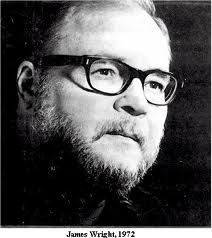
On James Wright


James Wright (December 13, 1927 – March 25, 1980) was a Pulitzer Prize-winning American poet who happens to have been born and raised in Martins Ferry, Ohio. Back then, Matins Ferry was one of the many steel-producing towns along the heavily industrialized Upper Ohio River Valley. The town borders West Virginina. Today, Martins Ferry is a dilapidated forlorn town struggling to survive. 

About fifteen years ago I discovered James Wright and have been a fan ever since. Here are two of his best known poems.

A Blessing  

Just off the highway to Rochester, Minnesota,
Twilight bounds softly forth on the grass.
And the eyes of those two Indian ponies
Darken with kindness.
They have come gladly out of the willows
To welcome my friend and me.
We step over the barbed wire into the pasture
Where they have been grazing all day, alone.
They ripple tensely, they can hardly contain their happiness
That we have come.
They bow shyly as wet swans. They love each other.
There is no loneliness like theirs.
At home once more,
They begin munching the young tufts of spring in the darkness.
I would like to hold the slenderer one in my arms,
For she has walked over to me
And nuzzled my left hand.
She is black and white,
Her mane falls wild on her forehead,
And the light breeze moves me to caress her long ear
That is delicate as the skin over a girl’s wrist.
Suddenly I realize
That if I stepped out of my body I would break
Into blossom.


Lying in a Hammock at William Duffy’s Farm 
in Pine Island, Minnesota 

Over my head, I see the bronze butterfly,
Asleep on the black trunk,
Blowing like a leaf in green shadow.
Down the ravine behind the empty house,
The cowbells follow one another
Into the distances of the afternoon.
To my right,
In a field of sunlight between two pines,
The droppings of last year’s horses
Blaze up into golden stones.
I lean back, as the evening darkens and comes on.
A chicken hawk floats over, looking for home.
I have wasted my life. 


So back in 1997 after I had just finished studying Wright’s collected poems, I wrote the following tribute poem. It was actually published, but the publisher wanted me to annotate it so the annotations are included.

In Ohio 

Yesterday, I sat alone
Affronting a candled cake,
Knowing that
Extinguishing the flames
Was saying good-bye to you,
James Wright.

One titanic year,
Your collection I lugged
In my bag
In my ghost:
Three pills a day
for a toothless addict.
*1

Three tiny teals
under a poplar tree,
Resurrecting anew with the sun.
I broke their necks with my paws
Swallowing nearly all,
Raw and naked.
*2 

Neglecting horses
and envying drunks,
I secretly watched little innocent girls
Lick the dew off the Ohio River jungle weed
and cried.
*3 

The industrial soot
of old Youngstown
Now displays my
tennis shoe print
And I am ashamed.

It doesn’t belong there,
Beside my father’s worn boot.
I did not burn rods 
in that filthy shop 
forty-seven years.

Still, I am too little 
for his singed flannel,
To see through the black glass 
of his hood. *4

James, you have become my horse,
Cantering ankle deep through
The muddy Ohio river towns.
They are too in me.
They are the branch
which will not break.
*5

Staring at my disheveled 
freshmen English class
from the lectern,
I stand alone.
 
While deep in the Ohio River 
flows old Youngstown,
And my father 
leisurely walks 
on her clouded surface
Leading a haltered horse
to Kentucky.

And I know,
I, too,
have wasted my life.
*6

*1 I was introduced to James Wright by poet, Terry Hermsen who spent a week working with my students on the writing of poetry. I picked up Wright's Collected Poems and spent the following year reading and studying three a day. Thus the birthday symbolically ends a year with Wright poetry. Toothless addict refers to
Wright's interest in the beat people of the streets. The speaker is alone because Wright loves to use this type of line to begins his poems. He will typically begin with a solitary speaker, move to imagery, and then return to the speaker's response to the imagery.

*2 A teal is a small duck. The word is used by Wright in one of his later poems, "Blue Teal's Mother." Poplar tree is a favorite nature image for Wright. There are three teals a day for I studies three poems a day. Raw and naked refers to Wright himself and his style which is both raw and naked.

*3 Wright loves horses and horse imagery in his poetry. The reference to drunks refers to Wright's alcoholism which he often refers to in his poetry. Watching little girls by the Ohio River is a typical Wright scenario. He likes to set up his poems with isolated speakers sadly
watching and being moved. Wright was from the river town of Martin's Ferry thus the reference to the river.

*4 Here the poem turns personal. Wright wrote much about family. Especially fathers. Thus here is the speaker's home town, the father, the metal-worker, and the speaker's awkward fit into the picture.

*5 As stated Wright is from an Ohio river town and he loved horse imagery.
Canter is used by Wright in his poem "Mary Bly" which is about the birth of Robert Bly's daughter. Wright and Bly were great friends. The speaker has also lived near South-Eastern Ohio river towns. The Branch Will Not Break is the title of one of
Wright's poetry collections and the last line in his poem, "Two Hangovers."

*6 Here is the return to the solitary speaker and the speaker's response. Wright and the father are leaving the speaker, Ohio, and are both walking on the river which is the basis of both their lives. The halter is symbolic of
the speaker realizing that by understanding his own father, he will also better understand Wright. The last line is Wright's most famous line. It ends his well-known poem, "Lying in a Hammock at William Duffy's Farm in Pine Island, Minnesota."